



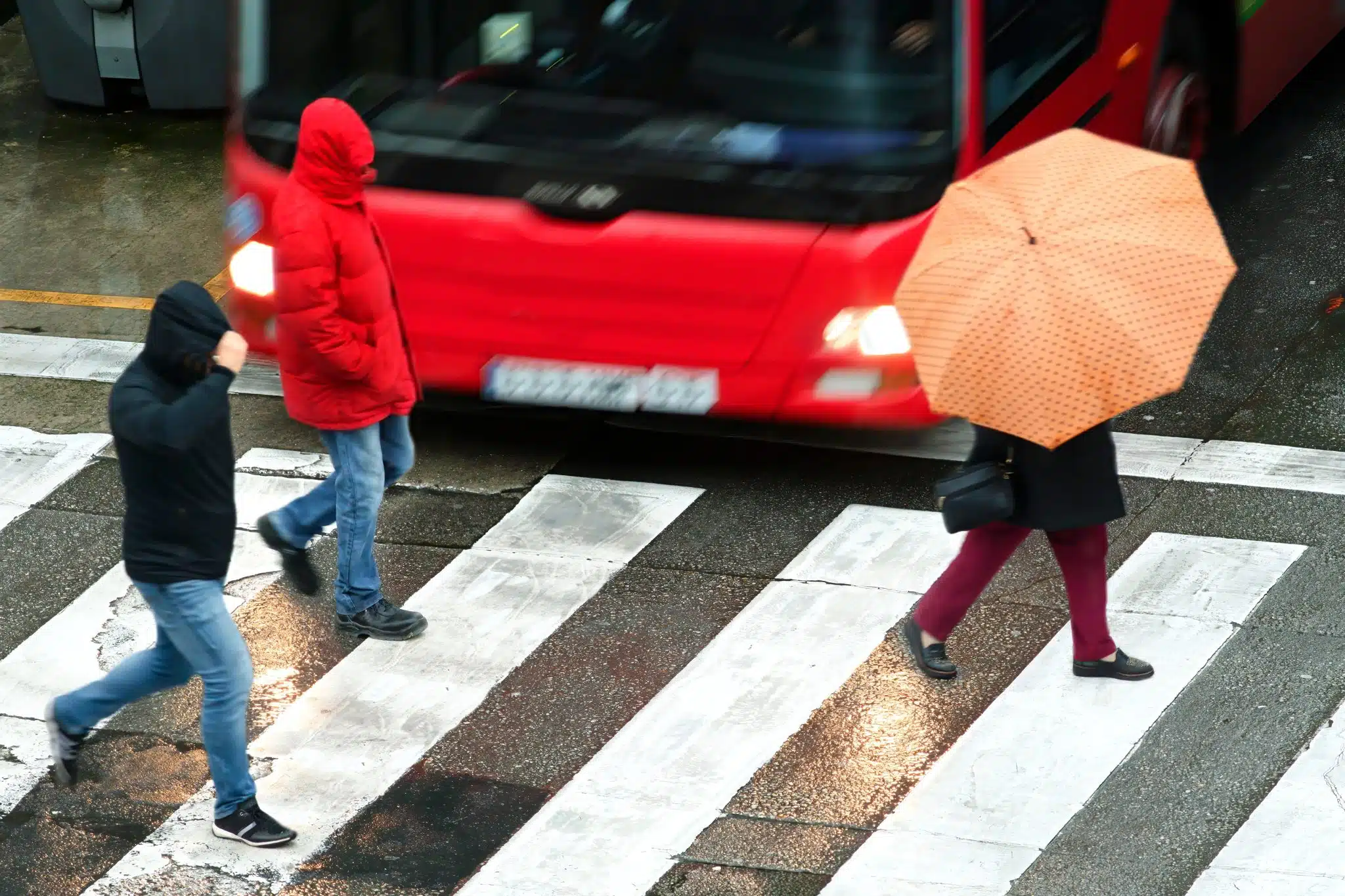
When a child is hurt in a crosswalk, the immediate focus is on the driver. But what if the driver was only part of the problem? What if the crosswalk itself was dangerously designed, the traffic signals were poorly timed, or a promised crossing guard never showed up?
In New York City, responsibility for a child’s injuries in a school zone could extend beyond the driver to the agencies tasked with keeping our streets safe, including the NYC Department of Transportation (DOT) and the Department of Education (DOE). These are complex cases that a seasoned New York City pedestrian accident lawyer is equipped to investigate.
While New York law provides protections for pedestrians, holding a city agency accountable for negligence is a difficult process. The government is shielded by a legal concept called sovereign immunity, which makes it challenging to bring a claim. However, this protection is not absolute. Families have successfully recovered compensation when evidence shows that the City failed to fulfill specific legal duties, such as its failure to install required pedestrian countdown signals at thousands of intersections by a 2020 deadline (American Council of the Blind of New York Inc. v. City of New York).
If you have a question about a crosswalk injury involving your child, call us at (866) 771-4988.
Key Takeaways for NYC School Crosswalk Accidents
- The City of New York may be liable for injuries, not just the driver. This is because the City has a duty to design and maintain safe streets, and failures like missing countdown signals or poor crosswalk design constitute negligence.
- You have only 90 days to file a Notice of Claim against a New York City agency. Missing this strict deadline will permanently bar your right to sue, making immediate legal action essential.
- Your child’s partial fault does not prevent your family from recovering compensation. New York’s pure comparative negligence rule allows you to recover damages reduced by your child’s percentage of fault.
Beyond the Driver: Municipal Liability for Dangerous Street Design
The real hazard may not have been just a careless driver, but the hazardous design of the crosswalk itself. The NYC DOT is aware of where these dangers lie, yet action is frequently delayed until tragedy strikes. Fortunately, legal avenues exist to hold the municipality liable for injuries caused by defective or dangerous roadway design.
The City of New York has a fundamental legal duty of care to maintain reasonably safe streets for all users. This duty is at the heart of its Vision Zero initiative, a program adopted in 2014 with the goal of eliminating all traffic fatalities and serious injuries. When the City fails to address known hazards through proper engineering, it may be held liable for the consequences.
The Countdown Clock Failure and Other Engineering Deficiencies
One of the most significant failures in recent years involves pedestrian countdown signals. In 2017, the City Council passed legislation requiring the DOT to install these signals at all eligible crosswalks by August 2020. The deadline was missed by a wide margin. If your child was injured at an intersection that lacked a required countdown clock, this failure creates a strong presumption of negligence on the City’s part.
Other engineering tools that the city sometimes fails to implement include:
- Leading Pedestrian Intervals (LPIs): These signals give pedestrians a head start of several seconds to begin crossing before vehicles get a green light. Studies have shown that LPIs significantly reduce pedestrian-vehicle collisions.
- Pedestrian Scrambles: Also known as a Barnes Dance, this design stops all vehicle traffic, allowing pedestrians to cross in every direction—including diagonally—at the same time.
The failure to implement these known safety measures, especially in high-traffic school zones, forms the basis of a powerful negligence claim. This is particularly relevant in boroughs like Brooklyn and Queens, which consistently see the highest number of pedestrian injuries.
The 250-Foot Problem and The Scope of the School Zone
It is a common misconception that most school-related pedestrian injuries happen directly in front of the school building. The reality is that the danger zone extends much further.
According to a child safety study, a high percentage of injuries to young people occur more than 250 feet from a school. Liability laws and the city’s duties shift depending on precisely where the accident occurred, which is why our investigation always covers this broader zone of danger.
A key legal concept in these cases is foreseeability. If an intersection is located on a known and predictable route that students use to walk to and from school, the City has a responsibility to ensure that the corridor is safe. This means it may be liable for failing to implement safety features like designated School Slow Zones or speed cameras, even if the intersection is several blocks away.
Is a Lack of Enforcement a Form of Negligence?
The presence of safety measures like speed cameras is only half the battle. If those cameras are not functioning, or if the city has a pattern of not issuing citations or enforcing penalties from them, a strong legal argument exists that this constitutes a breach of the city’s duty. Providing safety infrastructure without ensuring it works as intended creates a false sense of security and may contribute to a dangerous environment for student pedestrians.
Liability of the Department of Education and School Staff
In some situations, the school itself may share responsibility for a child’s injury. When your child is at school, the staff and administration act in loco parentis, a Latin term meaning “in the place of a parent.” This legal doctrine imposes a duty on the school to supervise children and protect them from foreseeable harm. While this duty typically ends once a child is dismissed for the day, there are important exceptions.
The school’s responsibility extends to dismissal procedures, including the safe loading of school buses and ensuring that children are released into a reasonably safe environment. If an accident occurs in the chaotic moments just after the final bell, we would carefully review the school’s official dismissal protocols to see if they were followed.
The Role of Crossing Guards
Many parents are surprised to learn that crossing guards are typically employees of the New York City Police Department (NYPD), not the Department of Education. If a designated crossing guard was absent from their assigned post, distracted by their phone, or left their post early without being relieved, a claim may be filed against the NYPD for this lapse in safety. The City cannot create the expectation of a safety professional at a corner and then fail to provide one without facing potential consequences.
The City cannot use its own educational programs as a legal shield. The DOT’s Cross This Way safety lectures for elementary school students do not absolve it of liability for defective street engineering. Telling a fourth-grader to look both ways does not excuse the failure to install a needed traffic signal.
The Driver’s Role: Heavy Vehicles and the Right of Way
While municipal liability is a large piece of the puzzle, the actions of the driver remain central. Statistics consistently show that the vast majority of pedestrian fatalities involve cars, trucks, and other heavy vehicles, as opposed to smaller vehicles like e-bikes.
Under New York Vehicle and Traffic Law § 1151, pedestrians have the right of way in a crosswalk, whether it is marked with painted lines or not. At any intersection, the area connecting the sidewalks on opposite sides of the street is legally considered a crosswalk. A common defense from drivers is, “I didn’t see a crosswalk,” but this is rarely a valid excuse. Unless signs explicitly prohibit crossing, drivers must yield.
What If My Child Was Partially at Fault?
This is one of the most common fears parents have. What if my child was distracted by a phone or stepped off the curb without looking carefully? It’s a valid concern, but it does not prevent you from seeking justice. New York follows a legal standard called Pure Comparative Negligence.
In simple terms, this rule means that you can still recover damages even if your child is found to be partially responsible for the accident. A court will assign a percentage of fault to each party involved. This system ensures that a small mistake does not prevent a family from receiving the financial support needed for a child’s recovery.
Procedural Hurdles: Sovereign Immunity and The 90-Day Rule
Suing a government entity like the City of New York involves procedural rules that do not apply to lawsuits against private citizens or companies. The most significant of these is the Notice of Claim.
To preserve your right to sue a New York City agency (such as the DOT, DOE, or NYPD), you must formally file a Notice of Claim within 90 days of the accident. This is not the lawsuit itself; rather, it is a mandatory prerequisite. If you miss this 90-day deadline by even one day, your case may be permanently barred, no matter how strong your evidence is.
Understanding Qualified Immunity and the Written Notice Rule
Beyond the strict deadline, you must also overcome the doctrine of Qualified Sovereign Immunity. This legal concept shields the City from liability for discretionary decisions, such as where to place a new park. However, the City is liable for proprietary failures, which involve the day-to-day maintenance of its property. An example would be knowing about a broken traffic light and failing to fix it in a reasonable amount of time.
For cases involving physical defects on the street, like a large pothole or a cracked and uneven crosswalk, another rule comes into play: the Pothole Law. This law generally requires you to prove that the City had prior written notice of the specific defect that caused the injury. Finding this evidence, such as previous 311 complaints, community board minutes, or internal DOT work orders, is a difficult task that we handle for our clients.
FAQ for Dangerous Crosswalks Near NYC Schools
Can I sue if my child was hit by an e-bike or moped near a school?
Yes. While this article focuses on municipal liability, the operator of any vehicle, including an e-bike or moped, has a duty to operate it safely. If the operator was negligent, you may bring a claim against their private insurance. If they are uninsured, you may be able to file a claim with New York’s Motor Vehicle Accident Indemnification Corporation (MVAIC), which provides coverage for victims of uninsured or hit-and-run drivers.
Does it matter if the accident happened 10 minutes after school closed?
It might. School Slow Zone speed limits are typically in effect during student arrival and dismissal windows. However, the City’s general duty to maintain safe streets does not end when the school day does. The time of the accident is an important fact, but it does not, by itself, determine whether you have a case.
The intersection had no crossing guard, but usually does. Is the City liable?
Potentially, yes. When the city assigns a crossing guard to a specific intersection, it creates an expectation of safety. If the city (through the NYPD) fails to ensure that post is covered and a child is injured as a result, it may be held liable for failing to provide that promised safety measure.
Are private schools treated differently than public schools regarding crosswalk safety?
With respect to the streets themselves, no. The NYC DOT is responsible for the design and maintenance of all public roads and sidewalks, regardless of what type of school is nearby. However, a private school may have different internal rules and potential liabilities regarding student supervision and dismissal procedures compared to a public school.
How do I prove the crosswalk was dangerous before my child got hit?
This is a central part of our investigation. We work to uncover evidence that proves the City knew or should have known about the hazardous condition. This involves obtaining years of accident history data for the intersection, discovering previous complaints made by community boards or local residents, and analyzing the DOT’s own internal studies and plans for the area.
We Demand Safer Streets for NYC Children
Do not let the City or an insurance company try to blame your child for an accident caused by their failure to design and maintain safe school zones. The data is clear—Vision Zero has not solved all of the problems, statutory deadlines for safety improvements have been missed, and dangerous intersections persist, particularly in Brooklyn, Queens, and the Bronx.
Your child’s recovery is the number one priority. Let us handle the investigation and the legal process so you don’t have to. Call The Rothenberg Law Firm LLP today to speak with a trusted New York City personal injury lawyer and secure your rights before the short 90-day window to file a claim closes.
Our number is (866) 771-4988.