


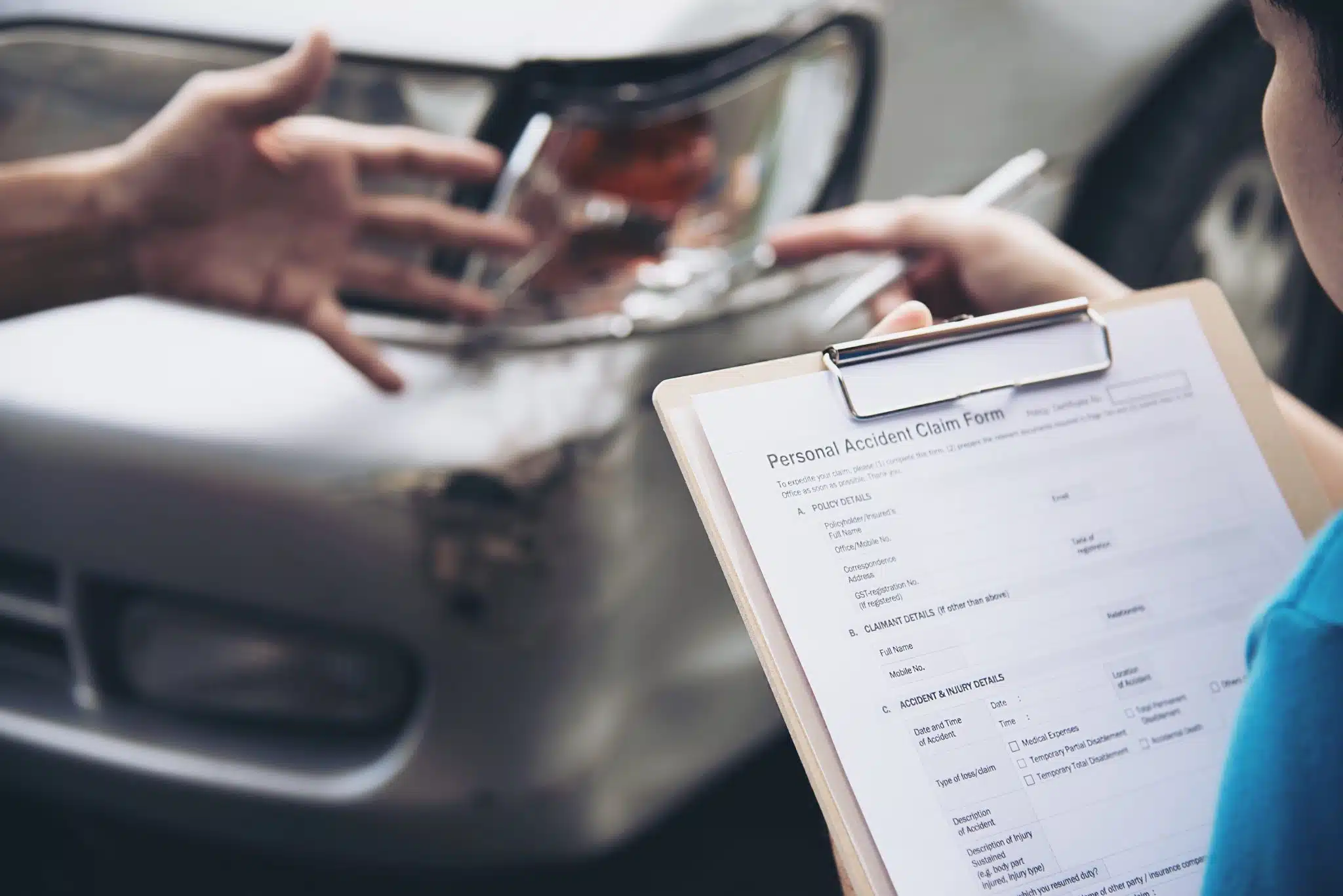
Being in a car accident is jarring enough. But when you see an out-of-state license plate on the car that hit you, a whole new layer of stress sets in. Do you have to travel to their state to get justice? How do their laws affect your claim? A knowledgeable Philadelphia car accident attorney can help answer these questions from the start.
Let’s clear up the biggest worry first: you do not have to leave Pennsylvania to pursue your claim. Thanks to a powerful legal tool called Pennsylvania’s Long-Arm Statute, you have the right to hold the at-fault driver accountable right here in a Philadelphia courthouse.
The core challenge, however, isn’t the location of the courthouse; it’s the out-of-state insurance policy. A driver from New Jersey, Delaware, or New York is covered by a policy written under their home state’s rules, which creates conflicts over coverage limits and what gets paid. While these claims involve more red tape, such as serving legal papers across state lines or managing a concept called “diversity jurisdiction” in federal court, the goal is always the same: to secure the compensation you need to be made whole.
At Rothenberg Law Firm LLP, we have years of experience untangling these difficult interstate claims. If you have questions about your accident, call us for a free consultation at (866)771-4988.
Key Takeaways for Philadelphia Accidents with Out-of-State Drivers
- You file your claim in Pennsylvania, not the other driver’s state. Pennsylvania’s Long-Arm Statute gives local courts jurisdiction over non-residents who cause accidents here, meaning you do not have to travel to get justice.
- Pennsylvania law, not the other driver’s home state law, applies to the accident. This ensures that Pennsylvania’s rules on fault and compensation govern the case, preventing the at-fault driver from using potentially unfavorable laws from their state to their advantage.
- Your own insurance is your primary protection against underinsured drivers. Since many states have low insurance minimums, your Uninsured/Underinsured Motorist (UM/UIM) coverage is essential for covering your damages if the at-fault driver’s policy is insufficient.
The Long-Arm of the Law: Why You Stay in Philadelphia
The key legal principle in these cases is Personal Jurisdiction. Simply put, a court only makes decisions that affect someone if it has authority over that person. To make sure that authority is fair, Pennsylvania, like all states, has a law known as a Long-Arm Statute (42 Pa.C.S. § 5322). This law gives our state’s courts jurisdiction over non-residents who cause harm within our borders.
In plain English, if someone drives on Pennsylvania’s roads, they are automatically agreeing to answer to our courts if they cause a wreck here. This is based on the “minimum contacts” rule, which says that by using our roads (a clear “contact” with the state), they have established a strong enough connection for our courts to have authority over them.
What does this mean for you in practice?
- You will file your personal injury lawsuit here in Philadelphia.
- The out-of-state driver will be required to hire a lawyer licensed in Pennsylvania to defend them here. Typically, their own insurance company will appoint and pay for this lawyer.
- The entire legal process, from filing to settlement negotiations to a potential trial, happens locally.
There is one nuance that may come up: Diversity Jurisdiction. This federal rule applies when a lawsuit involves parties from different states and the amount in controversy is more than $75,000.
In these situations, the defendant’s lawyer might move the case from the Philadelphia Court of Common Pleas to the U.S. District Court for the Eastern District of Pennsylvania. This sounds intimidating, but for you, it just means the trial would happen in a different building in Philadelphia. The location doesn’t change, only some of the procedural rules we have to follow.
Which State’s Laws Apply? (The Choice of Law Confusion)
A common point of confusion in claims against out-of-state drivers is figuring out which state’s rules to follow. Every state has different laws about who pays in an accident and how much they are responsible for. You might worry that the driver from a different no-fault or tort state could use their home state’s laws to reduce what they owe you.
For example, what if their home state has laws that are very protective of at-fault drivers? May they use those rules as a shield? Thankfully, the answer is almost always no.
The legal system resolves this issue with a concept called Lex Loci Delicti, a Latin term that means “the law of the place of the wrong.” Since the car accident happened in Philadelphia, Pennsylvania’s substantive laws will generally govern the case. This principle ensures that there is a consistent set of rules for any accident that occurs within the state, regardless of where the drivers are from.
How Pennsylvania’s Negligence Rules Affect Your Claim
One of the most important Pennsylvania laws that will apply is our state’s rule on shared fault, known as Modified Comparative Negligence. This rule, outlined in 42 Pa.C.S. § 7102, is also called the “51% Bar Rule.” It means you may recover compensation as long as you are found to be 50% or less at fault for the accident. Your final award is simply reduced by your percentage of fault. However, if you are deemed 51% or more to blame, you are barred from recovering anything.
This is a major advantage if the other driver is from a state with a stricter standard. Conversely, it prevents them from importing a more lenient rule. If their home state allows someone to be 99% at fault and still collect damages, that rule doesn’t apply here. Similarly, if they try to argue their state doesn’t permit damages for pain and suffering, Pennsylvania law overrides that because the injury happened on our soil.
The Role of the “Deemer” Statute
Pennsylvania law also has provisions to protect its residents from out-of-state insurance policies that don’t meet our standards. Under the Motor Vehicle Financial Responsibility Law, often involving what is known as a “deemer” statute, if an out-of-state insurance company is licensed to do business in Pennsylvania, it is “deemed” to have provided the minimum coverage required by Pennsylvania law, even if the policy was written in another state with lower requirements. This prevents situations where a Pennsylvania resident is left without adequate coverage simply because the at-fault driver was insured under a less comprehensive plan from another state.
The Insurance Gap: When State Minimums Don’t Match
It’s easy to assume that every driver on the road has a decent amount of insurance. Unfortunately, that’s far from true. Pennsylvania law requires drivers to carry a minimum of $15,000 in bodily injury liability coverage per person, $30,000 per accident, and $5,000 in property damage coverage. But these minimums vary significantly from state to state, and some are shockingly low.
This creates a serious risk for anyone injured in a collision. Consider these common scenarios:
- The New Jersey Basic Policy: Our neighboring state of New Jersey allows drivers to purchase a Basic insurance policy that may provide no bodily injury liability coverage at all. A driver with this policy is legally insured in New Jersey but, for the purposes of your injuries, is effectively uninsured.
- The Florida Problem: Florida is one of the few states that does not require its drivers to carry any bodily injury liability insurance whatsoever. A driver from Florida might only have coverage for damage to your car, leaving you with no immediate source of recovery for your medical bills and pain and suffering.
So, how do we cover your bills when the at-fault driver’s policy is inadequate or completely empty? The answer lies in your own insurance policy.
This is where Uninsured/Underinsured Motorist (UM/UIM) Coverage becomes the most important protection you have. If the out-of-state driver has no bodily injury coverage (making them uninsured) or their limits are too low to cover your damages (making them underinsured), you may file a claim with your own insurance company under your UM/UIM benefits.
This may feel unfair—why should your policy pay for someone else’s mistake? Think of it as a safety net that you paid for. Your insurance company will pay for your damages up to your policy limits, and then they will pursue the at-fault driver to get their money back through a process called subrogation. You don’t have to personally chase the driver for the money; your insurer handles it.
At the Rothenberg Law Firm LLP, one of the first things we do is demand the Declarations Page from both your policy and the defendant’s policy. This document outlines all available coverages. We meticulously review these pages to identify every possible source of recovery, including looking for umbrella policies or commercial policies if the vehicle was being used for work, such as a delivery truck from New York.
Serving the Lawsuit: Logistics of Finding a Distant Defendant
Once a lawsuit is drafted, it has to be formally delivered to the person you are suing. This is known as “service of process.” When the defendant lives in Philadelphia, this is straightforward. But when they live 400 miles away and may have even moved since the accident, it becomes a logistical challenge.
You cannot just mail a lawsuit. The law requires a specific procedure to ensure the defendant actually receives it. To accomplish this, we hire a professional process server in the defendant’s local county to hand-deliver the documents.
But what happens if the driver is intentionally avoiding service or cannot be located? Pennsylvania law has a solution for this exact problem. Under 42 Pa.C.S. § 5323, if a non-resident defendant cannot be found, we are permitted to serve the Pennsylvania Secretary of the Commonwealth as their designated agent. We then send a copy of the lawsuit by certified mail to the defendant’s last known address.
This legal step is designed to prevent a defendant from playing “catch me if you can.” By following this procedure, the law presumes the defendant has been properly served, even if they never sign for the letter. It stops them from being able to stall your case indefinitely and ensures the legal process moves forward.
Enforcing the Judgment: What If They Just Ignore It?
Let’s say you’ve successfully won your case and a Philadelphia judge or jury has awarded you damages for your injuries. But the out-of-state driver, now back in Ohio, simply refuses to pay. Do you have any recourse?
Absolutely. The framers of the Constitution anticipated this issue. The Full Faith and Credit Clause of the U.S. Constitution requires that judgments from one state be recognized and enforced in every other state. A judgment you win in a Philadelphia court is just as valid in Cleveland, Miami, or Los Angeles.
To enforce it, we “domesticate” the judgment in the defendant’s home county. This is a legal process where we file the Pennsylvania judgment with their local court. Once domesticated, that judgment has the full force of local law, allowing a sheriff in their jurisdiction to seize their assets, garnish their wages, or place a lien on their property to satisfy what they owe you.
Additionally, many states, including Pennsylvania, are part of the Non-Resident Violator Compact (NRVC). If an out-of-state driver ignores a traffic ticket or a civil judgment related to the crash, Pennsylvania notifies their home state’s motor vehicle department. Their home state will then suspend their driver’s license until the Pennsylvania judgment is paid. State lines are not a shield for evading responsibility.
FAQ for Philadelphia Accidents with Out-of-State Drivers
Does the claim take longer because the driver is from another state?
Sometimes, but not always significantly. Certain steps, such as serving the lawsuit and coordinating with out-of-state insurance adjusters, may add a few weeks or months to the timeline. However, it should not be the sole reason a case drags on for years.
Do I need a lawyer from their state or my state?
You need a lawyer licensed in the state where the accident happened: Pennsylvania. The entire case will be handled under Pennsylvania’s court procedures and laws. A local attorney from Rothenberg Law Firm LLP will be familiar with the Philadelphia judges and the rules of the courthouse where your case will be heard.
What if the out-of-state driver was in a commercial truck?
This changes everything for the better. Interstate trucking is a federally regulated industry, and the Federal Motor Carrier Safety Administration (FMCSA) mandates much higher insurance limits for commercial trucks, often starting at $750,000. In these cases, we typically sue the trucking company directly, providing a much more substantial source of recovery.
I have “Limited Tort” in PA. Does that apply with an out-of-state driver?
Generally, your Limited Tort selection still applies. However, there are several exceptions that help you overcome this limitation, such as if the at-fault vehicle is registered in a state that does not have a similar no-fault insurance system. We always analyze the specifics of the out-of-state driver’s registration and insurance to see if we might pierce the Limited Tort threshold.
What if they flee the scene and go back home?
This is a hit-and-run, which is a crime. Report it to the police immediately with as much information as you remember (license plate, vehicle description). For your injury claim, we would treat this as an accident with an uninsured motorist and file a claim under your own Uninsured Motorist (UM) coverage to pay for your damages while the police work to track down the driver.
Distance Does Not Equal Immunity
Don’t let the license plate on the other car intimidate you. The fact that the at-fault driver lives in Delaware, New Jersey, or even California changes the paperwork, not your fundamental rights. The law has built-in tools to ensure you are not left paying for a non-resident’s mistake.
Your focus should be on recovering from your injuries and getting your life back on track. Let us handle the interstate logistics, the different insurance adjusters, and the court filings, with a Philadelphia personal injury lawyer managing every detail.
If you were hurt by an out-of-state driver in a Philadelphia car accident and need clarity on your next steps, call the experienced attorneys at the Rothenberg Law Firm LLP at (866) 771-4988.