



New York’s Vision Zero plan acts as a double-edged sword for accident claims. On one hand, it provides a wealth of data, such as from expanded camera enforcement and detailed crash tracking, that is used to prove another driver’s negligence. On the other hand, it elevates the standard of care for every person on the road. This means that insurance adjusters and defense lawyers are looking more closely than ever for any sign of your own comparative fault.
While the first half of a recent year saw a historic 32% drop in traffic fatalities, accidents continue to disrupt lives across the five boroughs. When these incidents occur, the clash between post-pandemic aggressive driving and the city’s stricter Vision Zero infrastructure leads to complicated liability disputes. The safety initiatives, while lowering overall deaths, have created new arguments for insurance companies to use when trying to assign blame.
You do not have to confront the insurance giants by yourself. The very data generated by Vision Zero, such as camera footage and city crash reports, becomes powerful evidence for your case, provided you know where to find it and how to use it effectively, which is where an experienced New York City car accident lawyer can make a critical difference.
If you have questions about how local safety laws affect your specific crash, call us for a free consultation at (866) 771-4988.
Key Takeaways for Vision Zero Accident Claims
- Vision Zero creates powerful evidence of fault. The plan’s lower speed limits and widespread data collection from traffic cameras create clear proof when a driver violates the law, making it easier to establish their negligence.
- The city itself may share liability. If a poorly designed “safety improvement” like a confusing intersection or a misplaced barrier contributes to an accident, the city may be partially responsible, but you have only 90 days to file a formal Notice of Claim.
- Insurers use safety features to argue victim blame. Defense lawyers now point to bike lanes and pedestrian signals to argue you were comparatively at fault, which reduces your compensation, making it essential to counter these claims.
The “New Rules”: Statutory Liability and Speed Limits
One of the most significant changes under Vision Zero was the reduction of New York City’s default speed limit from 30 mph to 25 mph. Yet, many drivers continue to treat the old limit as the norm, creating dangerous conditions for everyone.
After a crash, you might find that an insurance adjuster tries to downplay the other driver’s speed, especially if they were “only” going a few miles over the new limit. They might argue that traveling at 33 mph in a 25 mph zone was not the true cause of the collision. This is a common tactic used to minimize their payout by suggesting the driver’s actions were reasonable, even if technically illegal.
This is where a key legal concept comes into play: a driver who violates a safety law, such as New York’s speed limit statute, NYS VTL § 1180, that causes the exact type of harm the law was designed to prevent is generally presumed to be negligent under the doctrine of negligence per se. Vision Zero’s explicit goal was to reduce severe injuries and deaths by lowering speeds. We use this legislative intent to argue forcefully that even “minor” speeding is a significant breach of a driver’s duty of care.
Furthermore, a 2022 state law gave municipalities the authority to set speed limits even lower than 25 mph in certain areas. If you were injured in a designated slow zone, the other driver’s liability is even more pronounced.
Electronic Evidence: How New York’s Vision Zero Plan Creates Data Trails
Vision Zero created a city-wide surveillance network that generates a constant stream of electronic data. For accident victims, this data is invaluable, transforming a case from a “he-said, she-said” dispute into a matter of objective fact.
Key Sources of Vision Zero Data
- School Zone Speed Cameras: These cameras, now operating 24/7 in many areas, may capture evidence of speeding. Even if a camera didn’t record the actual moment of impact, its data establishes a pattern of reckless driving. If the driver who hit you was ticketed for speeding just minutes before the crash, that information helps build a compelling narrative of their negligence.
- Traffic Studies and Crash Data: Local Law 58 of 2014 requires the city to track and analyze crash data, identifying high-injury networks and dangerous intersections. Our firm pulls these official reports to demonstrate that the city was aware of a location’s hazards, which strengthens the argument that drivers have a heightened duty of care in those areas.
- Black Box and Telematics Data: Many commercial trucks and city-affiliated vehicles are equipped with “black boxes” or telematics systems that record speed, braking, and other operational data. Vision Zero has also pushed for mandates like side guards on city-contracted waste trucks to protect cyclists and pedestrians. Immediately after a crash, we send a preservation letter demanding that this electronic data is not erased, as it provides a second-by-second account of the driver’s actions.
Municipal Liability: When the City Failed Its Vision Zero Promise
Sometimes, the driver who hit you isn’t the only party at fault. What happens when the very design of the road (a so-called “safety improvement”) contributes to the crash?
Suing a government entity like the City of New York is notoriously difficult. A legal doctrine called sovereign immunity generally protects government bodies from lawsuits. To proceed with a claim, you typically have to overcome the Prior Notice law, which requires you to prove the city had written notice of a specific defect (like a pothole) and failed to fix it within a reasonable time.
However, the city’s active role in redesigning streets under Vision Zero creates a potential exception. When the city installs new infrastructure like protected bike lanes, pedestrian islands, or turn-calming measures, it takes on the responsibility to design and implement them properly. If a confusing new intersection layout, a poorly placed concrete barrier, or a malfunctioning signal leads to an accident, the city may be held partially liable for creating a hazardous condition.
For example, Vision Zero mandated side guards on large city-contracted trucks to prevent pedestrians and cyclists from being pulled underneath the wheels. If you were struck by a city contractor’s truck that lacked these required guards, that is a direct violation of a city safety policy and could form the basis of a claim against both the truck owner and the city.
If you believe the City of New York may be partially responsible for your accident, you must act quickly. There is a very strict deadline: you must file a formal Notice of Claim with the appropriate agency within just 90 days of the incident. Miss this window, and your right to pursue compensation from the city is likely lost forever.
How Comparative Negligence Works in a Vision Zero Era
New York operates under a pure comparative negligence rule. This means you still recover damages even if you are found partially at fault for an accident. However, your final compensation will be reduced by your percentage of blame.
Vision Zero has added a new layer to how insurance companies and defense lawyers argue comparative fault, particularly for pedestrians and cyclists.
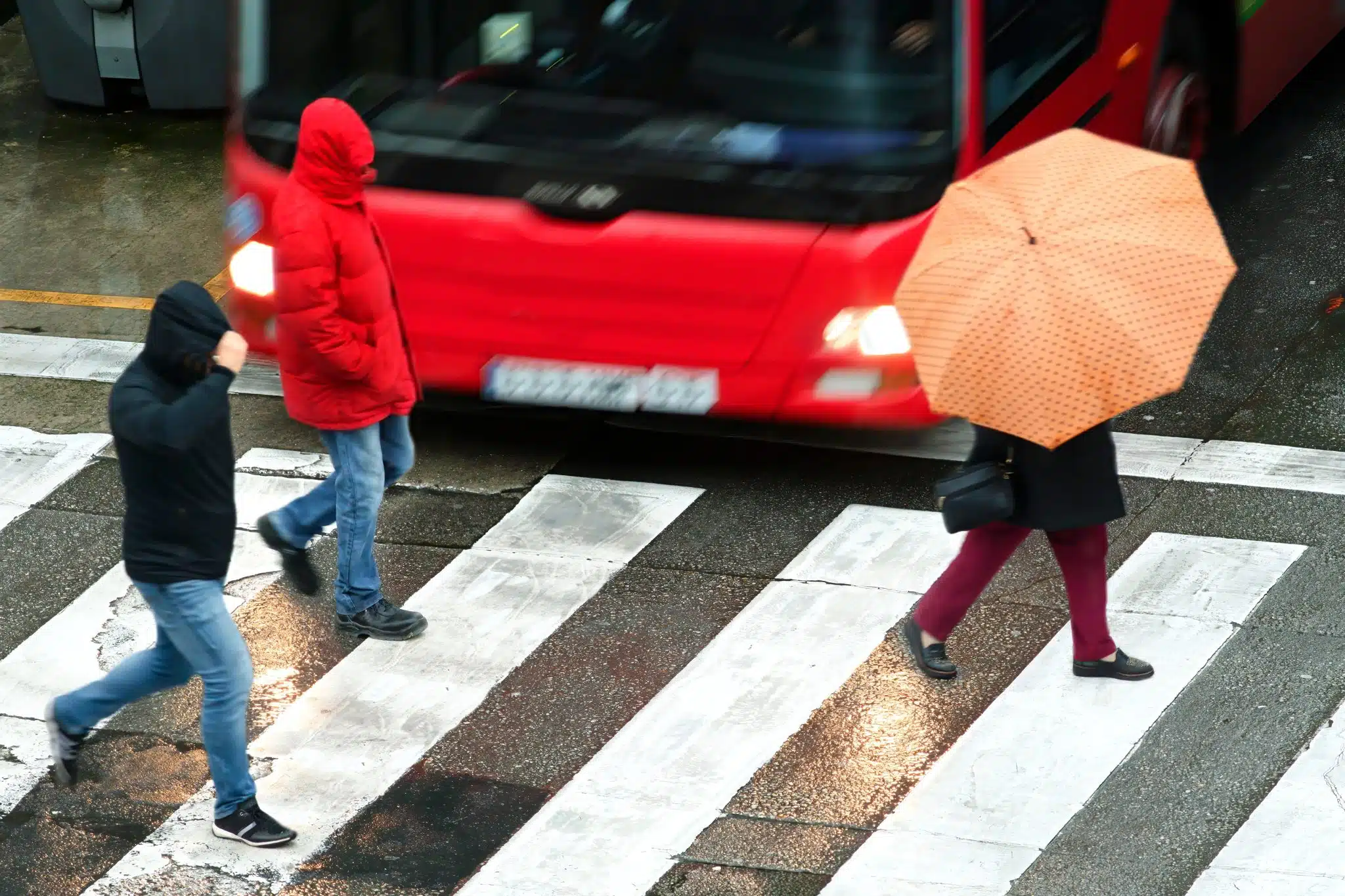
- Using Infrastructure Against You: Defense lawyers now use the very safety features designed to protect you as a way to assign blame. They will ask questions like, “Why weren’t you riding in the protected bike lane?” or “The city installed a Leading Pedestrian Interval signal; why didn’t you wait for it?”
- The Jaywalking Argument: While police rarely issue tickets for jaywalking anymore, crossing mid-block or against the signal is still used as evidence of your negligence in a civil claim. The defense will argue that you failed to use the available crosswalks and signals.
Our role is to push back against these arguments by focusing on the complete context of the incident. Even if you were crossing outside of a marked crosswalk, a driver still has a fundamental duty of care to see what is there to be seen and to operate their vehicle safely. In a known Vision Zero zone, that duty is arguably even higher. We argue that the primary cause of the crash was the driver’s inattention or aggression, not your minor deviation from ideal pedestrian behavior.
Dealing with Insurance: No-Fault vs. Bodily Injury
After a traffic accident in New York, your claim proceeds on two separate tracks.
The first phase is handled by your own insurance, regardless of who was at fault. This is part of New York’s No-Fault system. This coverage is designed to provide immediate payment for medical bills and lost wages up to a certain limit, typically $50,000. File your No-Fault application quickly; you have only 30 days from the date of the accident to submit it.
The second phase involves pursuing a bodily injury claim against the at-fault driver. To step outside of the No-Fault system and sue for damages like pain and suffering, you must prove that you sustained a “Serious Injury” as defined by New York law. This legal threshold includes injuries like fractures, significant disfigurement, or a permanent or significant limitation of a body organ or system. We work with your medical providers to gather the necessary documentation to prove your injuries meet this legal standard.
While Vision Zero has been successful in reducing minor collisions, the high-speed crashes that still occur result in devastating injuries that easily surpass the $50,000 No-Fault limit. When your medical bills and other economic losses burn through that initial coverage, we aggressively pursue the at-fault driver’s liability insurance policy to secure the full compensation available under the law.
FAQ for Vision Zero Accident Claims
Does a traffic camera ticket prove the other driver is at fault for my crash?
A speed camera ticket on its own doesn’t automatically prove fault for the crash itself, but it is a powerful piece of supporting evidence. It helps establish a timeline of the driver’s negligent behavior, showing they were violating traffic laws in the moments leading up to the collision. We use this to build a stronger case for their liability.
The speed limit sign on my street was recently changed. How do I know which limit applies?
The applicable speed limit is the one that was legally in effect and posted on the date of your accident. We investigate local administrative code changes and DOT records to confirm what the official speed limit was at the time of the crash, ensuring that a driver’s violation is properly documented.
Can I sue the City of New York for bad road design?
It is possible, but it is a difficult process. As mentioned earlier, you must file a Notice of Claim within 90 days and generally prove the city had prior written notice of a dangerous condition. However, if a newly implemented Vision Zero project created an inherently hazardous design, a claim may be viable. It requires a thorough investigation by a firm experienced in municipal liability.
For most negligence claims against another driver, the statute of limitations in New York is three years from the date of the accident. However, for claims against a municipal entity like the City of New York, the timeline is much shorter. You must file a Notice of Claim within 90 days, and then you have one year and 90 days from the date of the incident to file the actual lawsuit.
We Hold Reckless Drivers Accountable
Some drivers may think the 25 mph speed limit is just a suggestion. Some insurance companies may view your injury as just another number on a spreadsheet. We see things differently, and a dedicated New York City personal injury lawyer approaches your case with the seriousness it deserves.

New York’s Vision Zero plan has fundamentally changed the legal landscape for accident claims, equipping us with more data and clearer safety standards to build a fortress around your case. The laws are on the books, and the electronic evidence exists. Our job is to find it and use it to your advantage.
If you are ready to hand off the legal stress and focus on your physical recovery, our firm is prepared to handle the rest. Call Rothenberg Law Firm LLP today at (866) 771-4988 for a free and confidential consultation.