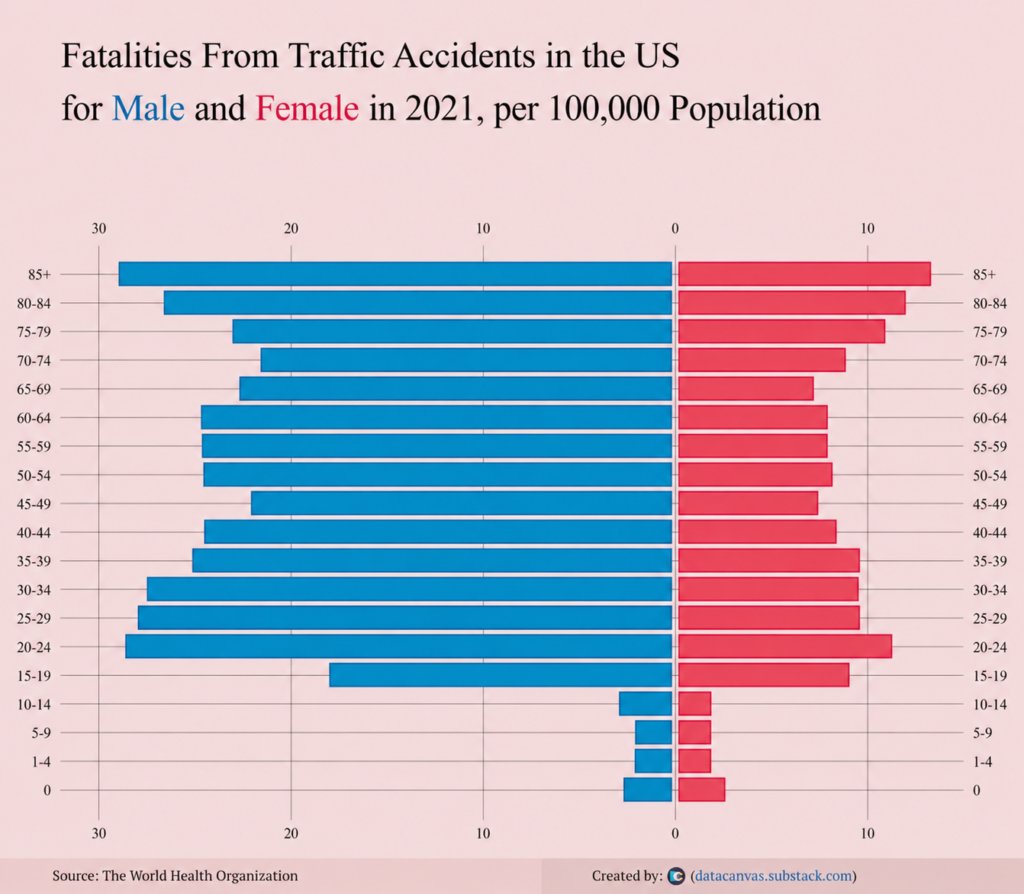
Traffic accidents affect every age group in America, but they do not affect everyone equally. The chart below, based on World Health Organization data, compares traffic accident fatalities among males and females in the United States in 2021 per 100,000 people. The pattern is clear: males experienced higher fatality rates than females across nearly every age group.
That difference matters. It helps explain who faces the greatest risk on the road, how risk changes with age, and why serious crashes often require a careful investigation into driver behavior, vehicle type, road conditions, and other factors.
Thanks to https://datacanvas.substack.com/ for the chart.
Men Face Higher Traffic Accident fatality Rates Across Most Ages
The most striking takeaway from the chart is the consistent gap between male and female traffic accident fatalities. From the teenage years through older adulthood, male fatality rates are generally much higher than female rates.
The gap is especially visible among younger adults. Men ages 20 to 34 show some of the highest fatality rates on the chart, reaching close to 30 fatalities per 100,000 people in certain age groups. Female fatality rates also rise during young adulthood, but they remain substantially lower.
Several factors may help explain this pattern. Research has associated higher male crash risk, particularly among younger men, with factors such as greater exposure to driving, speeding, nighttime driving, impaired driving, and motorcycle use. Men also tend to drive more miles on average, which increases exposure to crash risk.
Young Adults Are a High-Risk Group
The chart shows a sharp increase in traffic accident fatalities beginning in the late teenage years. Rates rise noticeably among males ages 15 to 19 and peak among males in their 20s and early 30s.
This is the age range when many drivers are gaining independence, commuting more frequently, driving at night, and spending more time on highways or urban roads. It is also an age range associated with distracted driving, speeding, and impaired driving risks.
For families, this data is a reminder that young drivers and passengers need clear safety habits early. Seat belt use, avoiding phone use behind the wheel, refusing to ride with impaired drivers, and understanding the consequences of speeding can reduce risk.
For injured people, the age of the driver is only one part of the picture. A serious car accident claim may require evidence such as police reports, crash scene photographs, witness statements, traffic camera footage, vehicle damage, phone records, and medical documentation.
Older Adults Also Face Serious Risk
Another important trend appears at the top of the chart. fatality rates rise again among older adults, especially those age 75 and above. Male fatality rates remain higher than female rates, but both groups see elevated risk in later life.
Older adults may be more physically vulnerable in a crash. A collision that causes moderate injuries to a younger person may cause catastrophic harm to an older person, including fractures, traumatic brain injuries, internal injuries, or complications that require long-term care.
This does not mean older adults are always at fault for crashes. Many older drivers and pedestrians are injured because another driver failed to yield, followed too closely, ran a red light, or drove distracted. In pedestrian accidents, older adults may be especially vulnerable at intersections, parking lots, and crosswalks.
When an older person is injured in a traffic accident, the legal claim should account for the full impact of the injury, including medical care, rehabilitation, lost independence, pain and suffering, and future care needs.
Female fatality Rates Are Lower, But the Risk Is Still Real
Although females show lower fatality rates than males in most age groups, the chart does not suggest that women are safe from traffic accident harm. Female fatality rates rise during young adulthood and again among older age groups.
Women may be injured as drivers, passengers, pedestrians, cyclists, rideshare passengers, or motorcyclists. In some cases, women may also face unique medical complications after a crash, including pregnancy-related concerns, worsening of pre-existing conditions, or delayed symptoms that do not appear immediately.
Anyone injured in a crash should seek medical attention and avoid assuming the injury is minor. Symptoms from concussions, soft tissue injuries, spinal injuries, and internal trauma may develop hours or days later.
What This Data Means After a Serious Traffic Accident
Traffic fatality data helps identify broad patterns, but a legal claim depends on the facts of a specific crash. If you were injured in a car, truck, motorcycle, bicycle, pedestrian, or rideshare accident, the key questions usually include:
- Who caused the crash?
- Were any traffic laws violated?
- Was a driver distracted, speeding, impaired, or fatigued?
- Did road conditions, vehicle defects, or commercial trucking rules play a role?
- What medical care do yfou need now and in the future?
- How has the accident affected your work, family, and daily life?
Insurance companies may move quickly after a crash. They may ask for a recorded statement, question the severity of your injuries, or offer a settlement before the full cost of recovery is clear. You do not have to navigate that process alone.
Talk to The Rothenberg Law Firm After a Traffic Accident
The data shows that traffic accident fatalities affect Americans of every age and gender, with especially high risks among men, young adults, and older adults. But behind every data point is a person dealing with pain, stress, medical bills, and uncertainty about what comes next.
The Rothenberg Law Firm helps injured people and families in New York, New Jersey, and Pennsylvania understand their rights after serious traffic accidents. Contact us today for a free consultation to discuss your case and learn your options. You pay no attorney fees unless we recover compensation for you.